Free Guide
The CT IEP Form, Explained
If you are new to the IEP process, the paperwork alone can feel like its own maze to navigate.
Start the GuidePick a Page
All 16 pages of the Connecticut State Department of Education IEP form are below.
Click a Number
Each numbered marker on the form opens our tips for that section.
Click Again to Close
Click the same number to close the tip. The arrows under the form take you to the next page.
1Welcome!
Connecticut school districts write IEPs on a standard statewide form, completed in the state's special education data system, CT-SEDS. Every student with an Individualized Education Program (IEP) has their plan written on this form.
This guide walks through the form page by page, explaining what each section means so you can take part in your child's Planning and Placement Team (PPT) meetings with confidence.
2The First Two Sections
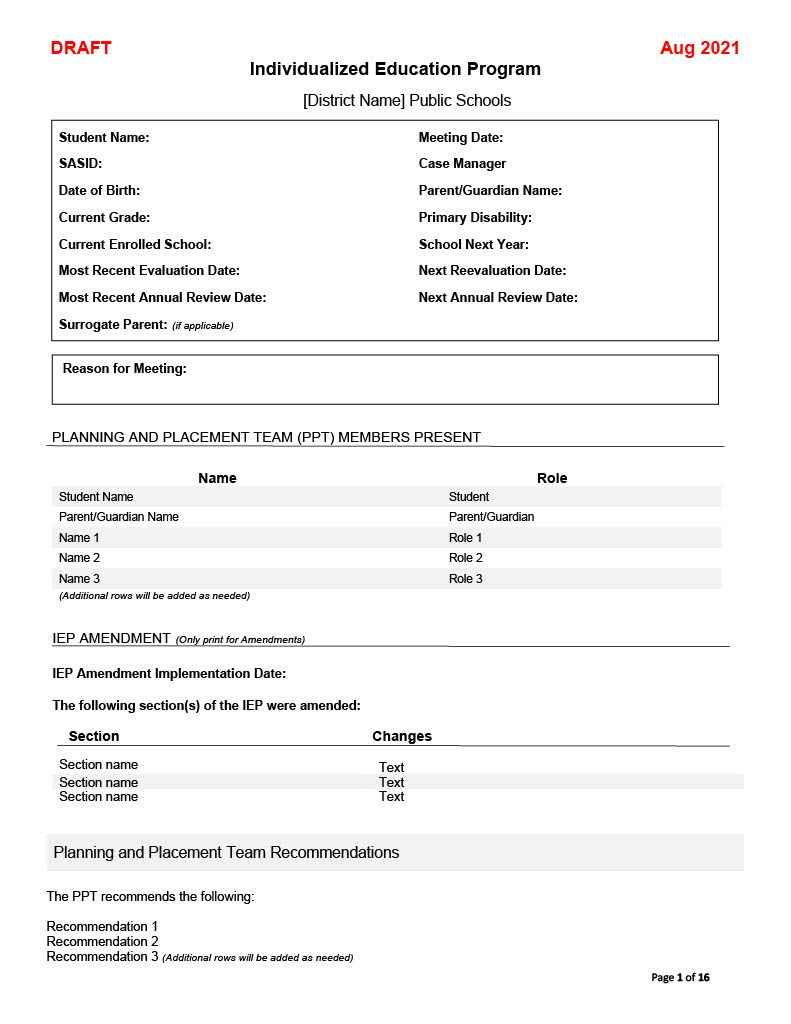
The first two sections of the IEP hold the basic information about your child and the meeting.
3SASID
This is the State Assigned Student Identifier
The SASID is a ten digit unique number that is assigned to each student upon entry into a Connecticut public school including publicly funded preschool programs as well as standard elementary, middle and high schools.
4Disability Categories
The IDEA offers 13 Disability Categories but CT offers a few more. The form does not list the options, so it is important for you to acquaint yourself with each one to effectively advocate for your child's needs. The Primary Disability Categories you can use in CT are listed below.
- Autism
- Emotional Disability (ED)
- Multiple Disabilities
- Orthopedic Impairment
- Speech or Language Impaired
- Deaf-Blindness
- Hearing Impairment (Deaf or Hard of Hearing)
- Developmental Delay (ages 3-5 only)
- Intellectual Disability (ID)
- Specific Learning Disabilities (SLD)
- Traumatic Brain Injury
- Specific Learning Disabilities (SLD)/Dyslexia
- Visual Impairment
- Other Health Impairment (OHI)
- OHI-ADD/ADHD
- To be Determined
It is like learning a new language to better communicate and advocate for your child's education. Remember, you can do this!
5Current Enrolled School
This is the school district's proposed school for your child. If your child is privately placed, that program will not be reflected here.
6Next School Year
This is the school district's proposed educational program for your child for next school year.
7Most Recent Evaluation Date
Your school is obligated to re-evaluate your child every three years. The last evaluation date should be listed here.
8Next Reevaluation Date
This is when your child's next re-evaluation is due.
9Most Recent Annual Review Date
Your child's IEP must be reviewed at least annually, by the annual review date. This is when the last one was held.
10Next Annual Review Date
The next annual review meeting is due by this date. You may request a PPT at any time to discuss your child's program, but the annual date typically stays the same.
11Surrogate Parent
Surrogate Parents is only relevant for children in foster care. Under the IDEA, a "Surrogate Parent" is appointed to advocate for the special education needs of children in foster care. In Connecticut, surrogate parents are independent contractors hired, trained, and supervised by the Department of Education.
12Reason for Meeting
Planning and Placement Team (PPT) meetings can be called for various reasons, which should be listed here. The form does not include a checklist of reasons, so if more than one applies, they should all be listed. Common reasons include the following.
- Review Referral
- Plan Evaluation/Reevaluation
- Review Evaluation/Reevaluation
- Determine Eligibility
- Determine Continuing Eligibility
- Develop IEP
- Review or Revise IEP
- Conduct Annual Review
- Transition Planning
- Manifestation Determination
Remember to keep these factors in mind when reviewing your notices, as they remain integral parts of the process.
If your child is facing suspension or expulsion and a Manifestation Determination meeting is scheduled, contact an attorney right away. The timelines are short, and the outcome affects your child’s placement.
13Planning and Placement Team (PPT) Members Present
Everyone who attended the PPT meeting should be listed here, along with their role. Every meeting should have a special educator, an administrator, a regular education teacher (if your child participates in regular education), relevant service providers, and someone who can interpret any evaluations being discussed.
14IEP Amendment
If you and the school agree on a change to the IEP, it can be amended without holding a PPT meeting, and the changes should be listed here. If you do not agree with a proposed change, ask for a PPT meeting so your concerns become part of the official record.
15Recommendations
The Team Recommendation is the school district's proposed plan, whether or not you agree with it. If you do disagree with the school's recommendations or make any requests that are refused, you should also receive Prior Written Notice (PWN) documenting this.
If the school refuses a request you believe your child needs, an attorney can help you decide whether to pursue it through mediation or due process.
16What Is Not on the IEP
Two important documents are not part of the Connecticut IEP form, the Summary and the Prior Written Notice.
The Summary is optional, and your school may or may not complete it. You can write your own summary and ask that it be attached to the IEP or kept in your child's educational file, so your concerns are on the record.
The Prior Written Notice is NOT optional. It may or may not arrive with the IEP, so watch for it and keep it with your IEP.
1Special Considerations
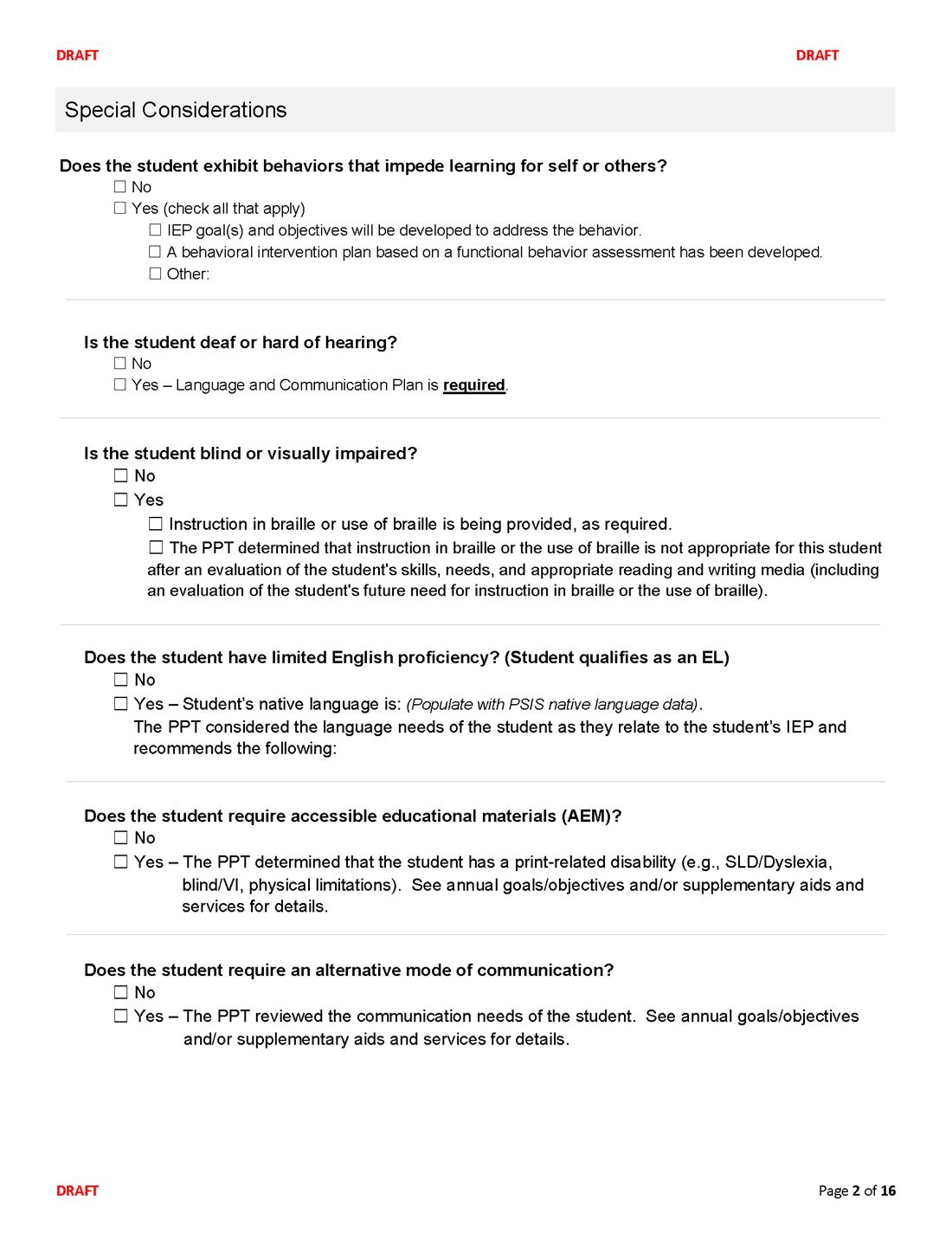
Any special factors your child's team must consider should be noted here, so the IEP addresses your child's unique needs.
2Functional Behavior Assessment (FBA)
In Connecticut, a Functional Behavioral Assessment (FBA) done on its own is not considered a comprehensive evaluation for which you have a right to request an independent educational evaluation (IEE) at public expense. If the FBA was part of a comprehensive evaluation, however, it may support an IEE request. Courts may interpret this differently, so watch for future decisions. For more, see D.S. v. Trumbull Board of Education, 120 L.R.P. 28133 (2d Cir. 2020).
1Academic, Pre-Academic, Cognitive Achievement
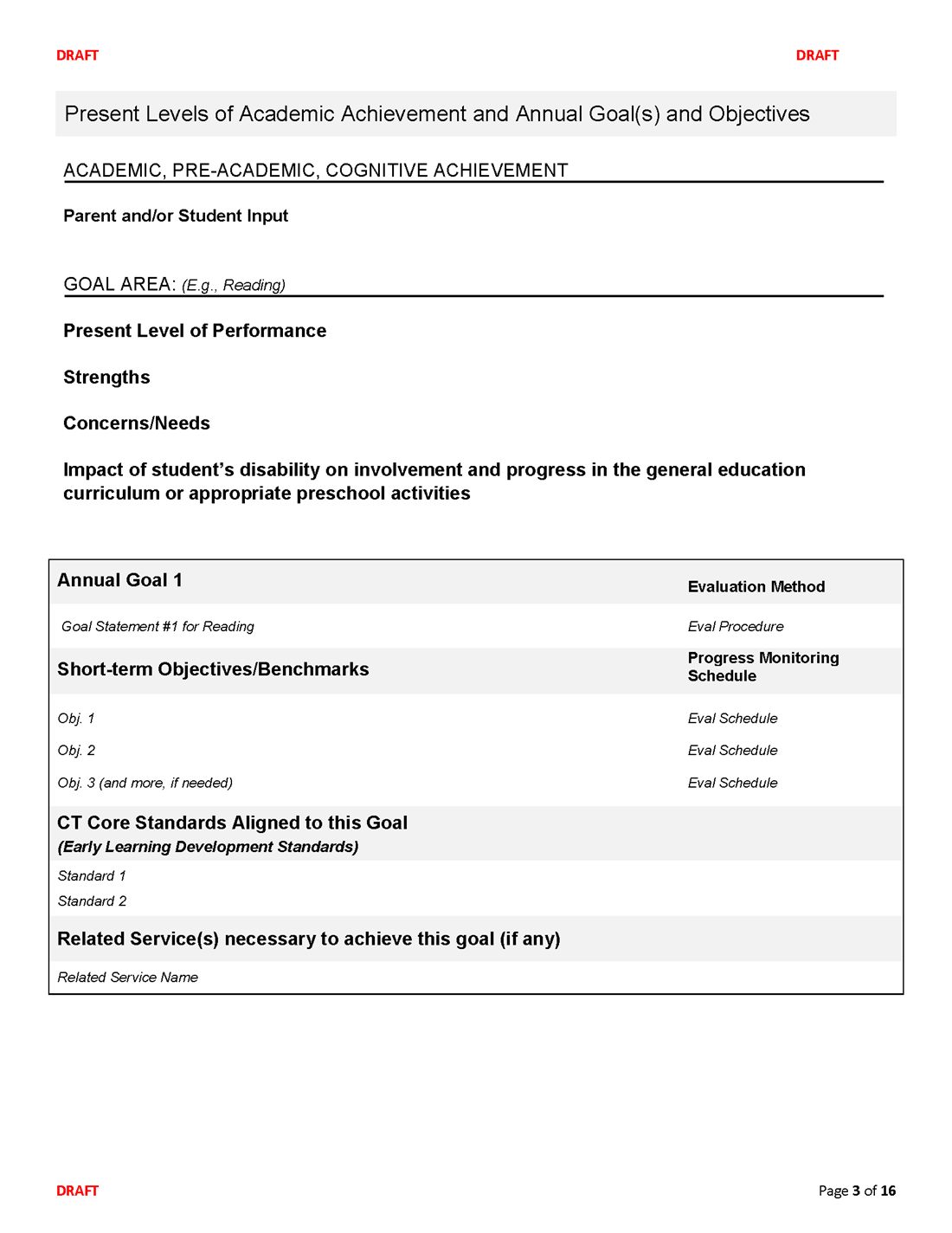
Your child's academic goals and short-term objectives are listed here, along with how and when progress will be measured. Schools are required to align goals with CT Core Standards and list the related services your child will need to reach them.
2Parent and Student Input
Parent and Student input comes first in each area of Goals and Objectives. The concerns listed here should relate only to Academic, Pre-Academic, and Cognitive Achievement.
3SMART Goals and Objectives
Every goal should be SMART.
- Specific. It says clearly what your child will do, and where and when.
- Measurable. There is a way to measure progress and know when the goal is met.
- Achievable. It is realistic for your child with the right supports in place.
- Relevant. It is tied to your child's needs and the bigger picture of their education.
- Time-bound. It has a deadline.
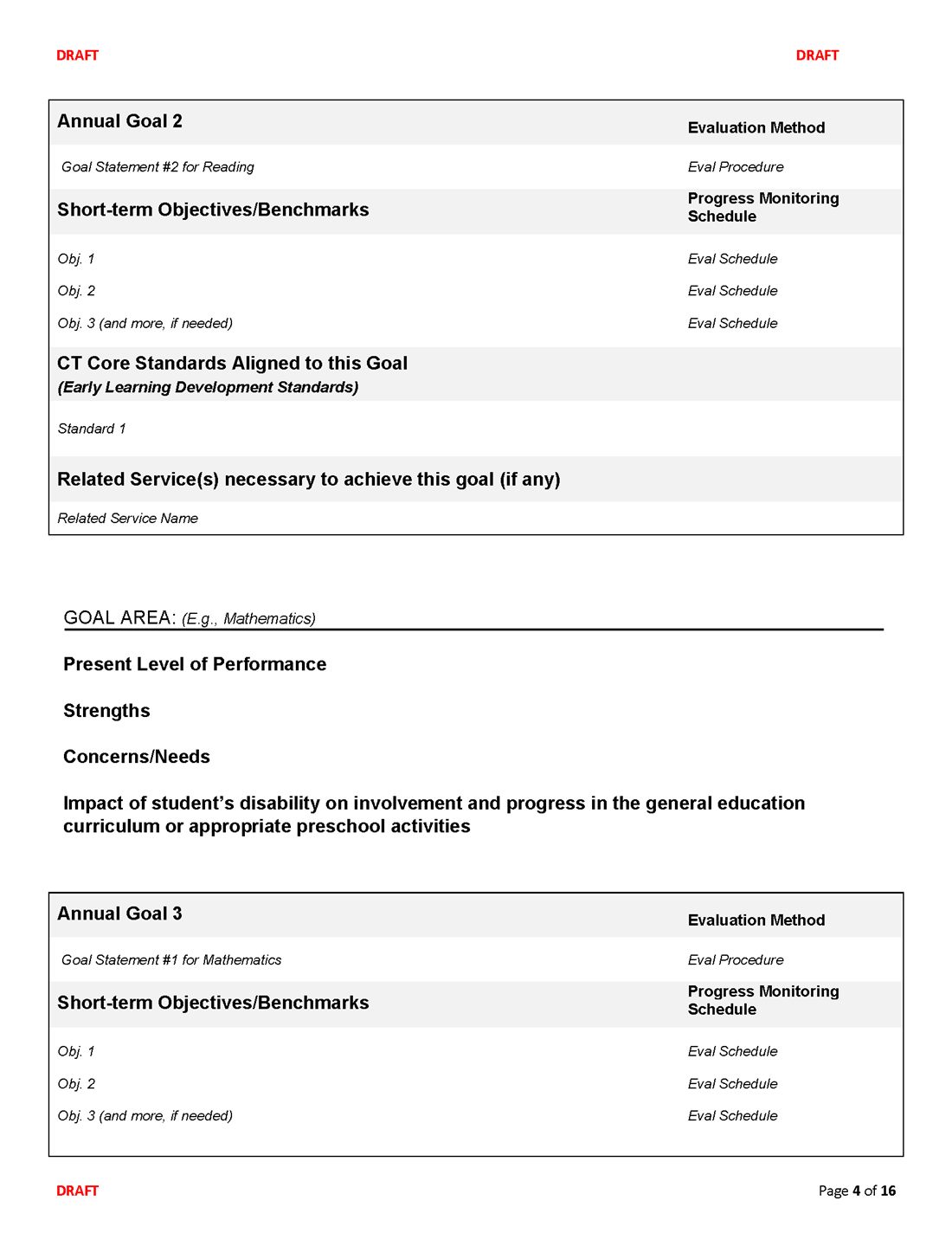
1Goals & Objectives
There is no limit to the number of Goals and Objectives your child can have, but each one is expected to be met within one calendar year. If they cannot all fit into the daily schedule, your team should consider an extended day.
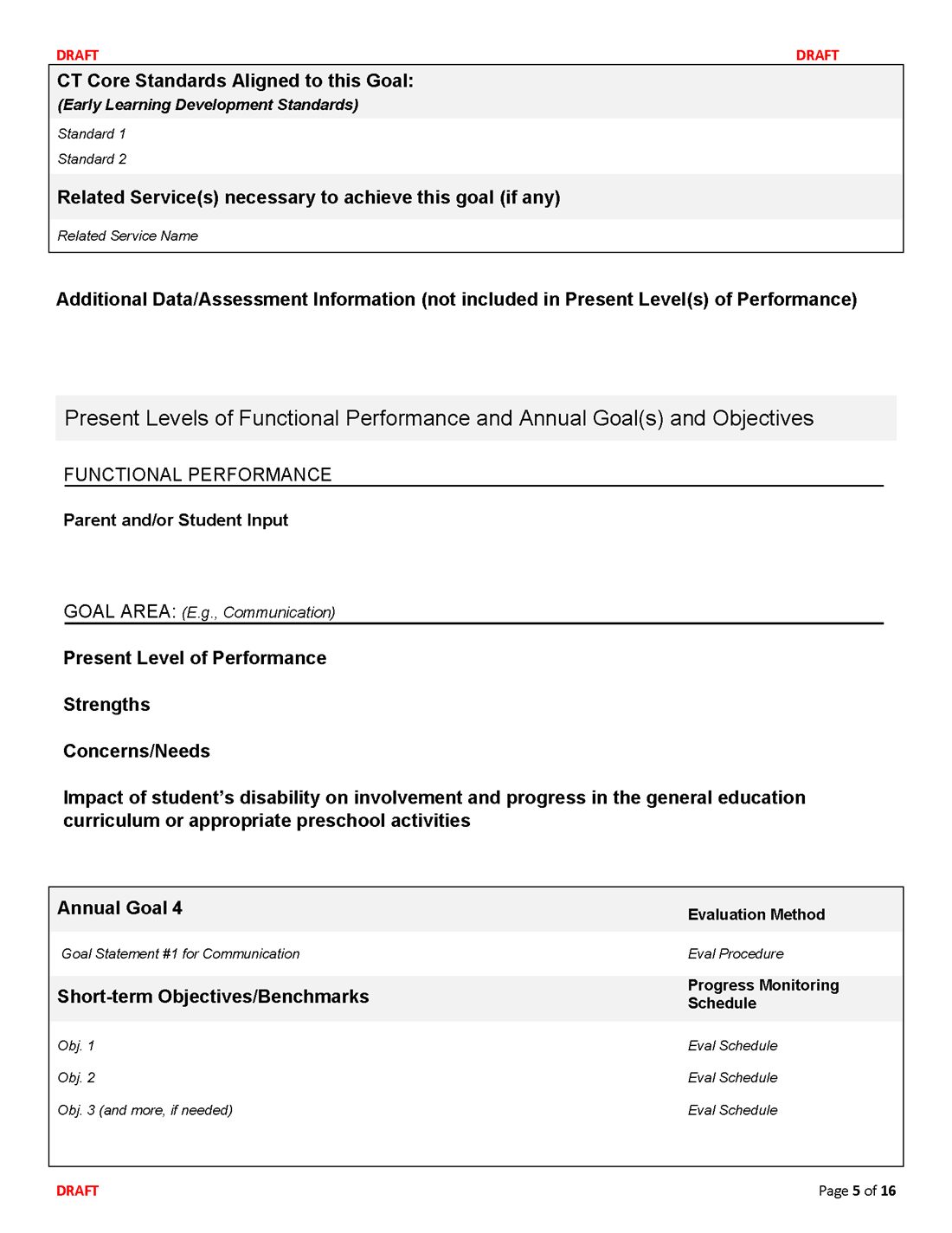
1Functional Performance
Functional Performance skills are those your child needs in everyday life, beyond academics. Goals for these skills go here. These can include self-care, social skills, and vocational skills.
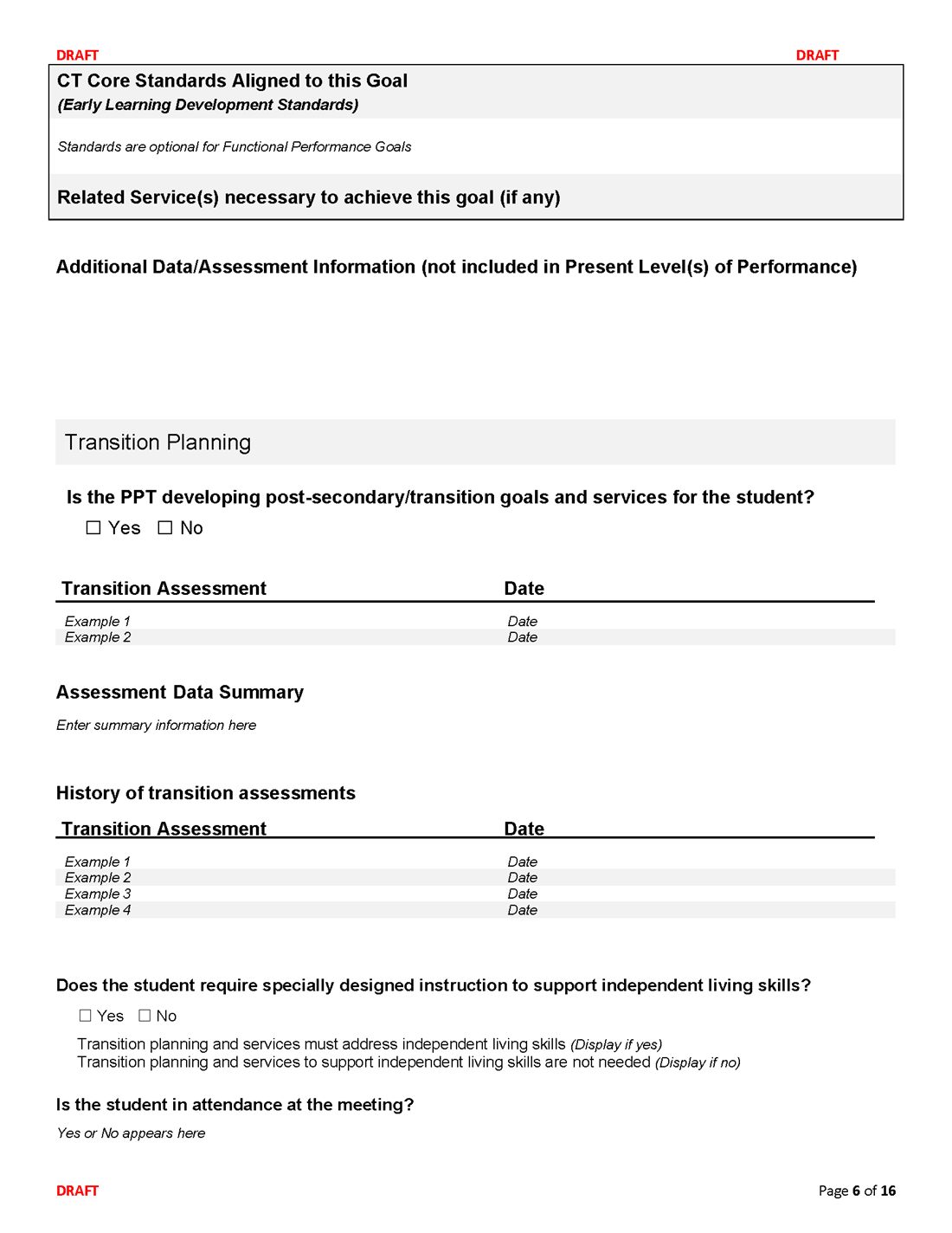
1Transition Planning
Transition planning prepares your child for life after high school, whether that means college, vocational training, work, or other paths.
2By age 14
In Connecticut, transition planning must begin by the time your child turns 14, or earlier if appropriate. Starting early leaves time to build the plan around your child's goals and needs.
3Transition Assessments
Transition assessments help the team understand your child's strengths, preferences, interests, and needs for education, employment, and independent living after high school. The results are used to set realistic goals and decide which services your child needs.
Assessments can be formal, like vocational aptitude tests or life skills checklists, or informal, like interviews, questionnaires, or observing your child in a job setting. They should be repeated as your child grows and their goals change. Your child's input is central, and yours matters too.
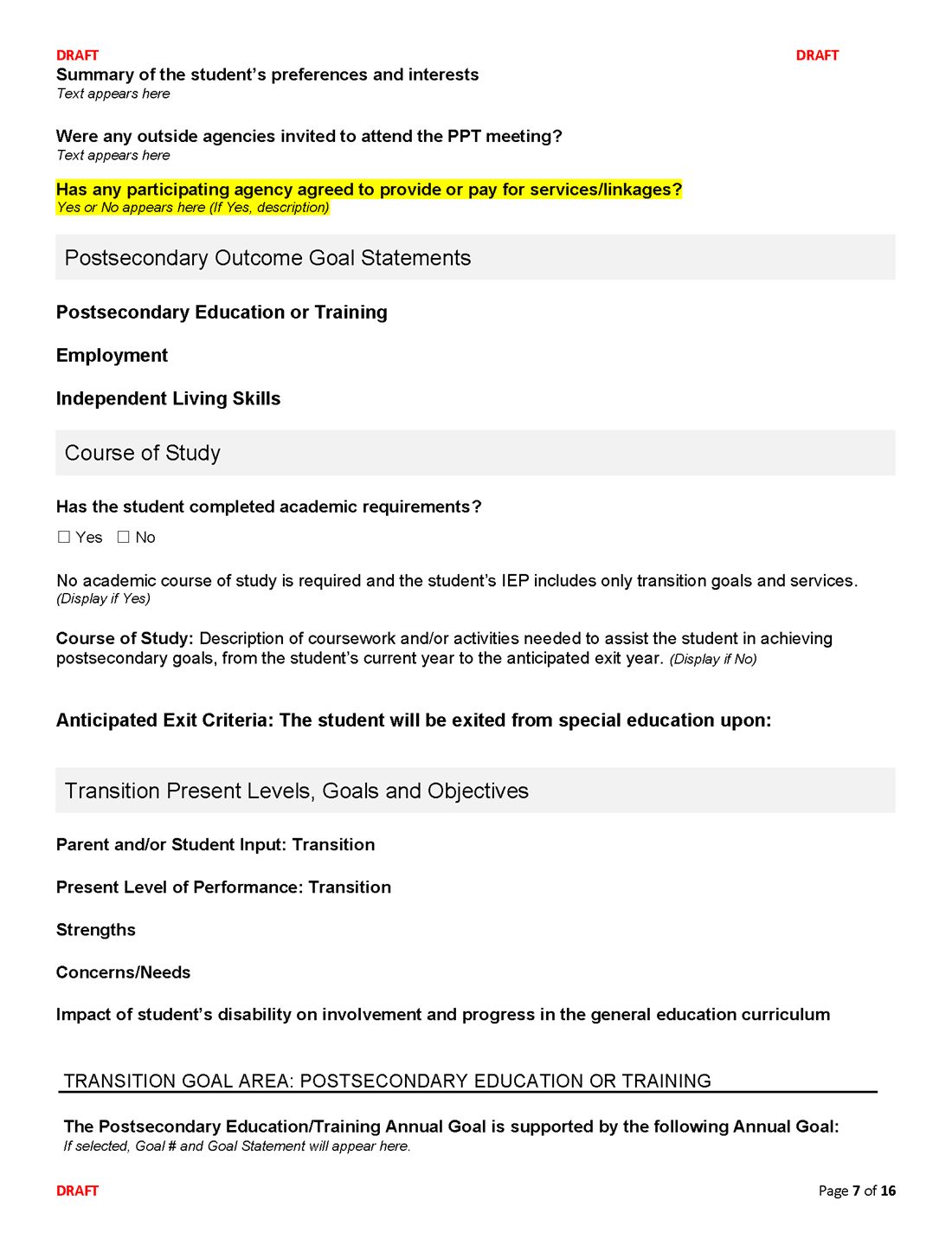
1Outside Agencies
Not every student will have outside agencies involved in their post-secondary life, but for those who do, the agencies should be invited before the student is exited. The school must get your permission before inviting any agency to a PPT meeting.
2Agency paying?
If an outside agency has agreed to provide or pay for transition services, it should be noted here. This could include vocational training, educational assistance, life skills programs, or job placements and internships.
3Postsecondary Outcome Goal Statement
These statements describe what your child wants to do after high school, in education or training, employment, and, when appropriate, independent living. For example, "After graduation, [Student's Name] will attend a technical institute to study automotive technology."
The whole team helps write them, including your child and you. They should be updated as your child's goals change.
4Course of Study
The high school courses your child will take to prepare for their goals after graduation should be listed here.
5Transition Present Levels, Goals, and Objectives
This is where you put all those transition assessments to work! Your child's present levels and transition goals should be based on the results.
6Postsecondary Education or Training
Your child's goal for post-secondary education or training goes here. In Connecticut, every transition plan must have a Postsecondary Education or Training goal AND an Employment goal. Independent Living Skills should be addressed if needed.
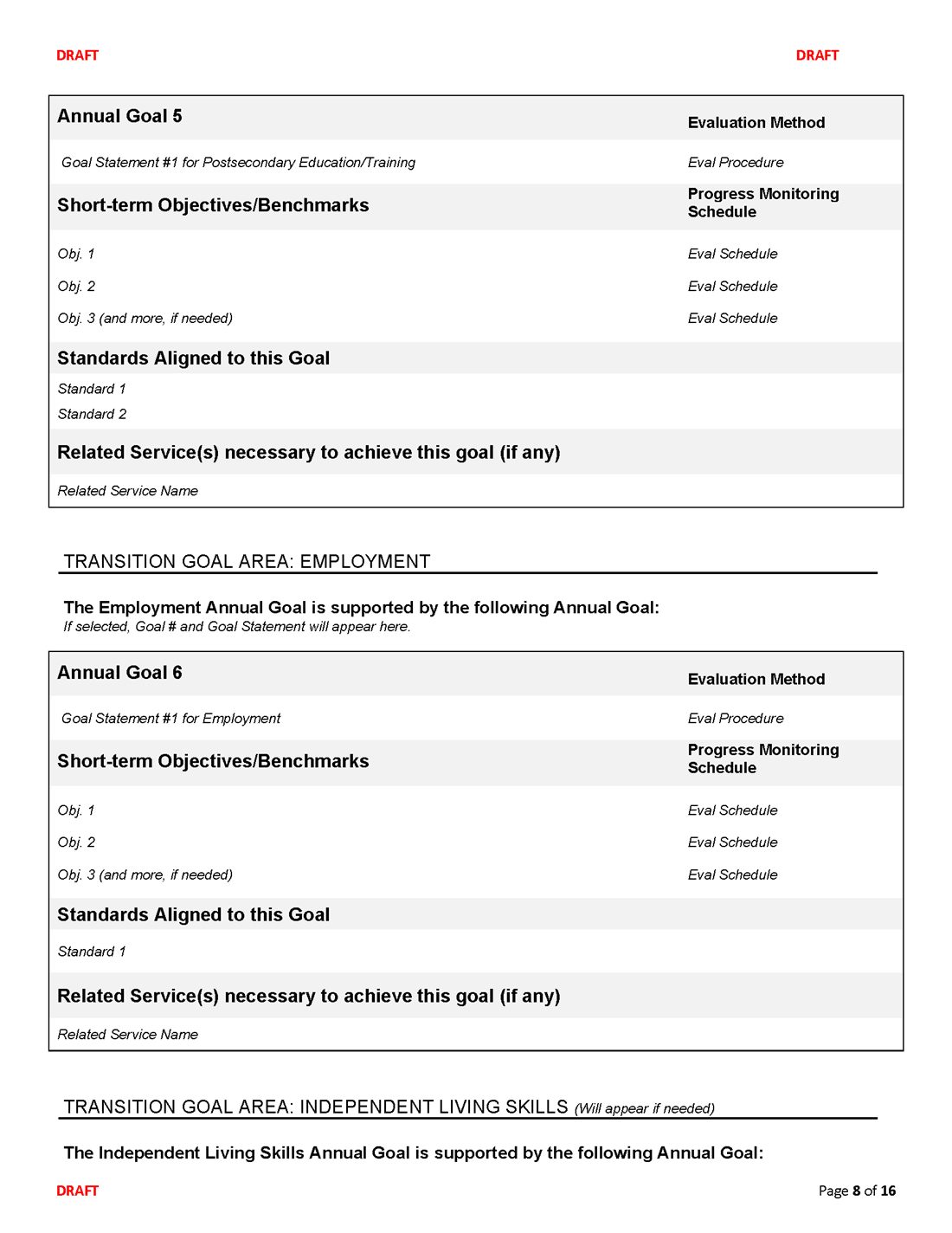
1Employment
Your child's employment goal goes here. In Connecticut, every transition plan must have an Employment goal AND a Postsecondary Education or Training goal. Independent living skills are addressed if needed.
2Independent Living Skills
Independent Living goals are included based on your child's individual needs. Unlike the Employment and Postsecondary Education or Training goals, they are not required for every student in Connecticut.
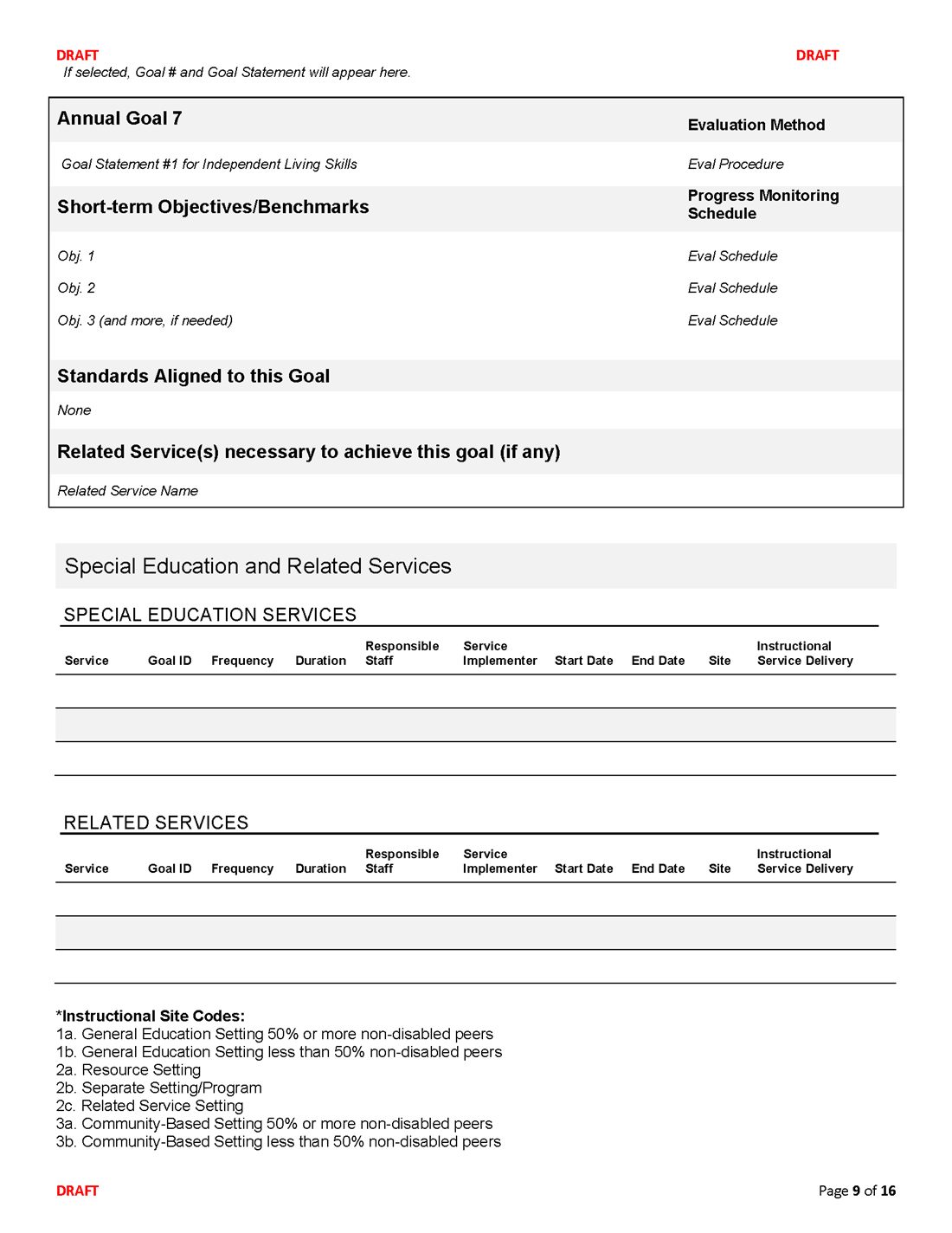
1Special Education and Related Services
The special education and related services your child will receive are listed here. These should be based on your child's needs, not the school or staff schedules.
2Services
Special education is the instruction designed for your child's needs. For example, it could be one-on-one reading instruction for a child with dyslexia or modified math instruction for a child with an intellectual disability.
3Related Services
Related services help your child access and benefit from special education. They can include speech and language therapy, occupational therapy, physical therapy, counseling, and transportation.
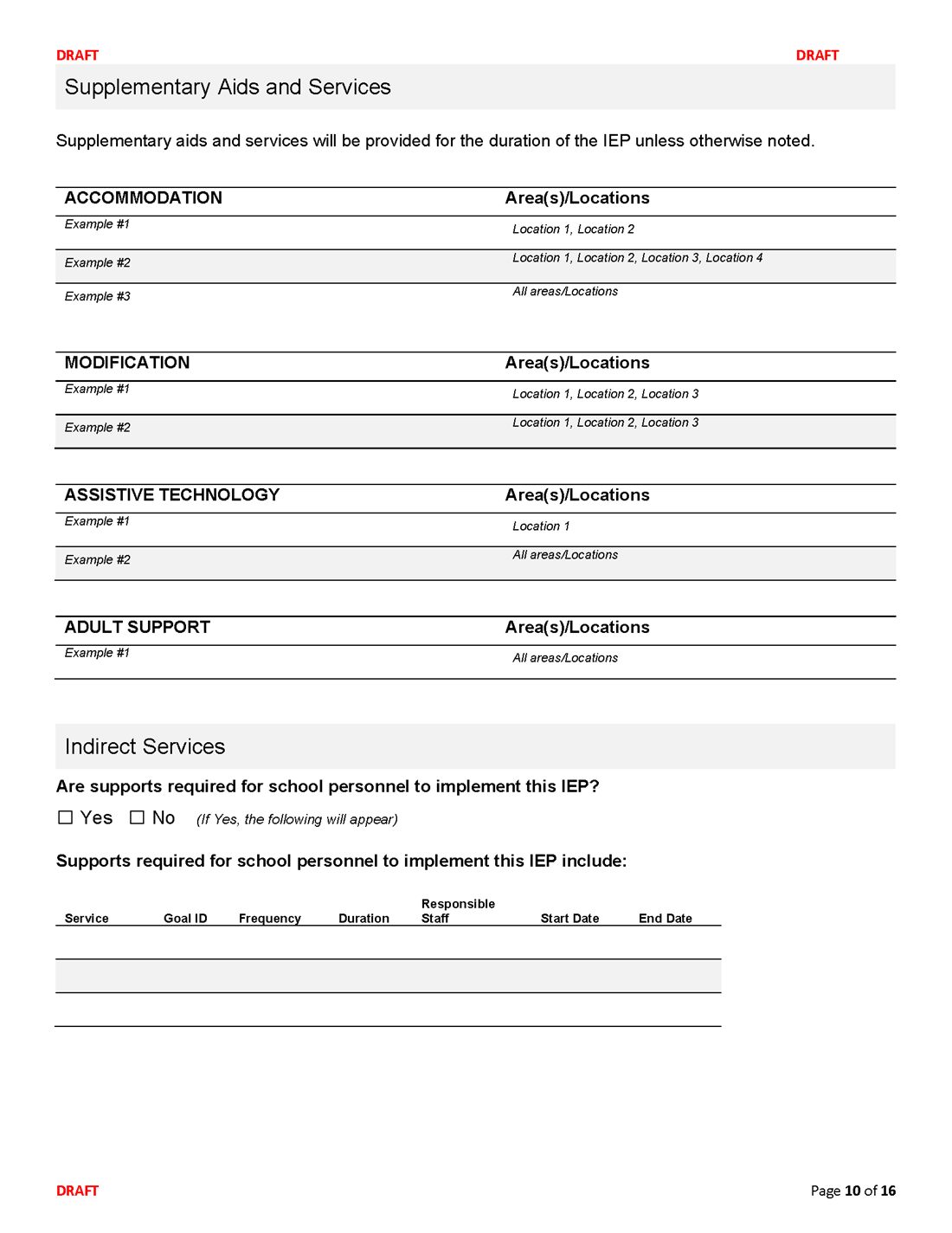
1Supplementary Aids and Services
Supplementary aids and services are the supports that help your child learn in regular education classes and other school settings. They include accommodations, modifications, assistive technology, adult support, and indirect services.
2Accommodations
Accommodations are the HOW — they change how your child learns or shows what they know, without changing what they are expected to learn. Examples include the following.
- Extended time for tests or assignments
- Written or audio instructions
- Assistive technology, like screen readers
- Breaks during tasks
- Step-by-step instructions
3Modifications
Modifications are the WHAT — they change what your child is expected to learn or do. Examples include the following.
- Fewer problems or shorter assignments
- Simplified readings that cover the same content
- A different project or different questions
- An adjusted grading scale
- Different materials, like a textbook in simpler language
- Focusing on only specific concepts of a unit
4Assistive Technology (AT)
Assistive technology is any device, software, or equipment that helps your child access their education. It can be as simple as a pencil grip or as complex as speech-to-text software.
5Adult Support
Any additional adult who supports your child should be listed here, such as a one-on-one aide, job coach, interpreter, or therapeutic staff. The type and amount of support should match your child's needs.
6Indirect Services
Indirect services support the adults around your child rather than your child directly. Examples include training teachers on a teaching method, advising on behavior strategies, or giving families strategies to support learning at home.
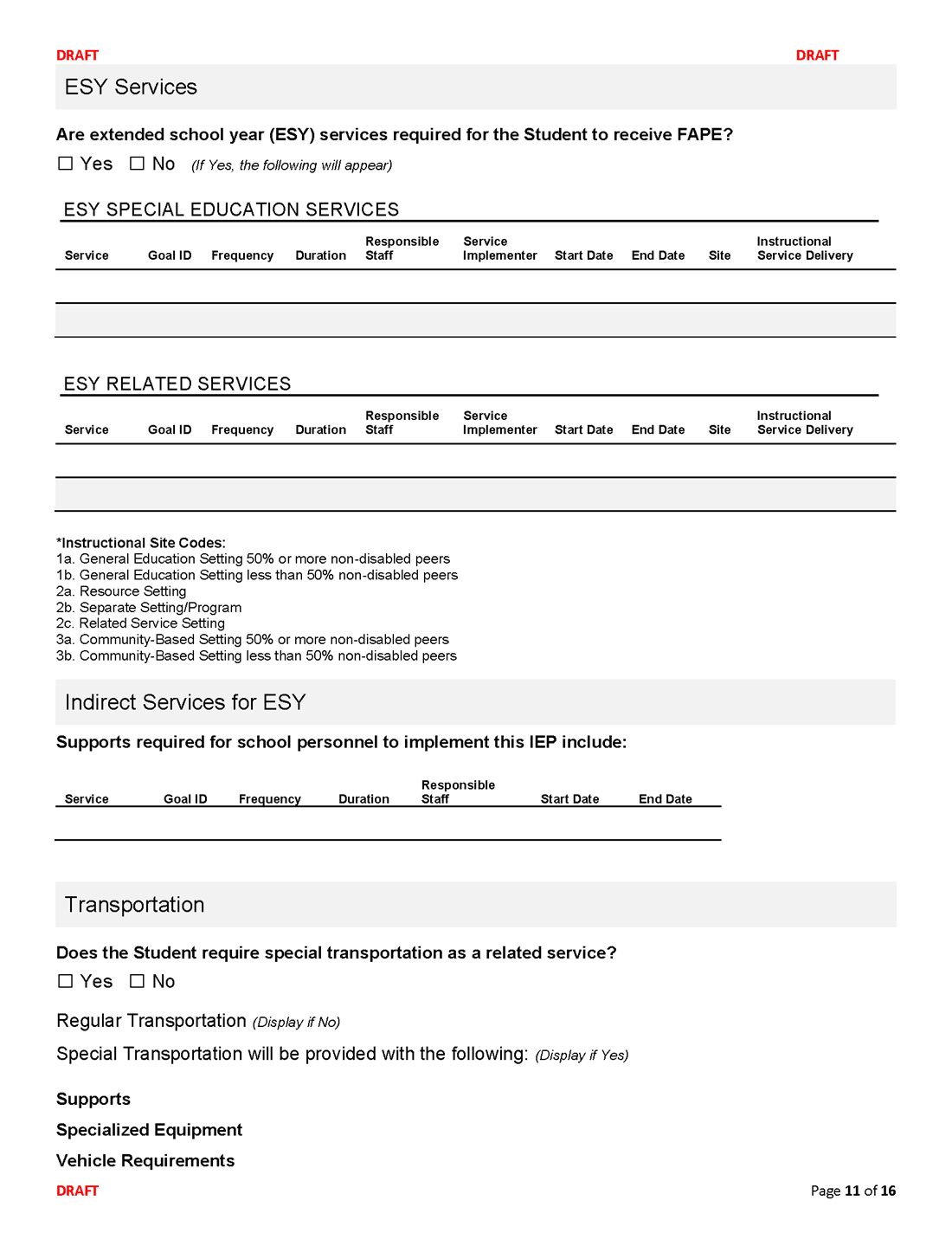
1Extended School Year (ESY) Services
Extended School Year (ESY) services are special education and related services provided beyond the regular school year. Typically ESY refers to summer services.
Students are entitled to ESY services if they regress more than their peers during breaks or if the severity of their disability is such that they require the additional time to meet their goals and objectives.
If ESY is denied and your child loses skills over breaks, an attorney can help you challenge the decision.
2Transportation
Transportation is a related service. Any special transportation your child needs to and from school, or between schools, should be listed here. For some children it is a seat on a regular bus, and for others it may mean a wheelchair-accessible vehicle or extra supervision.
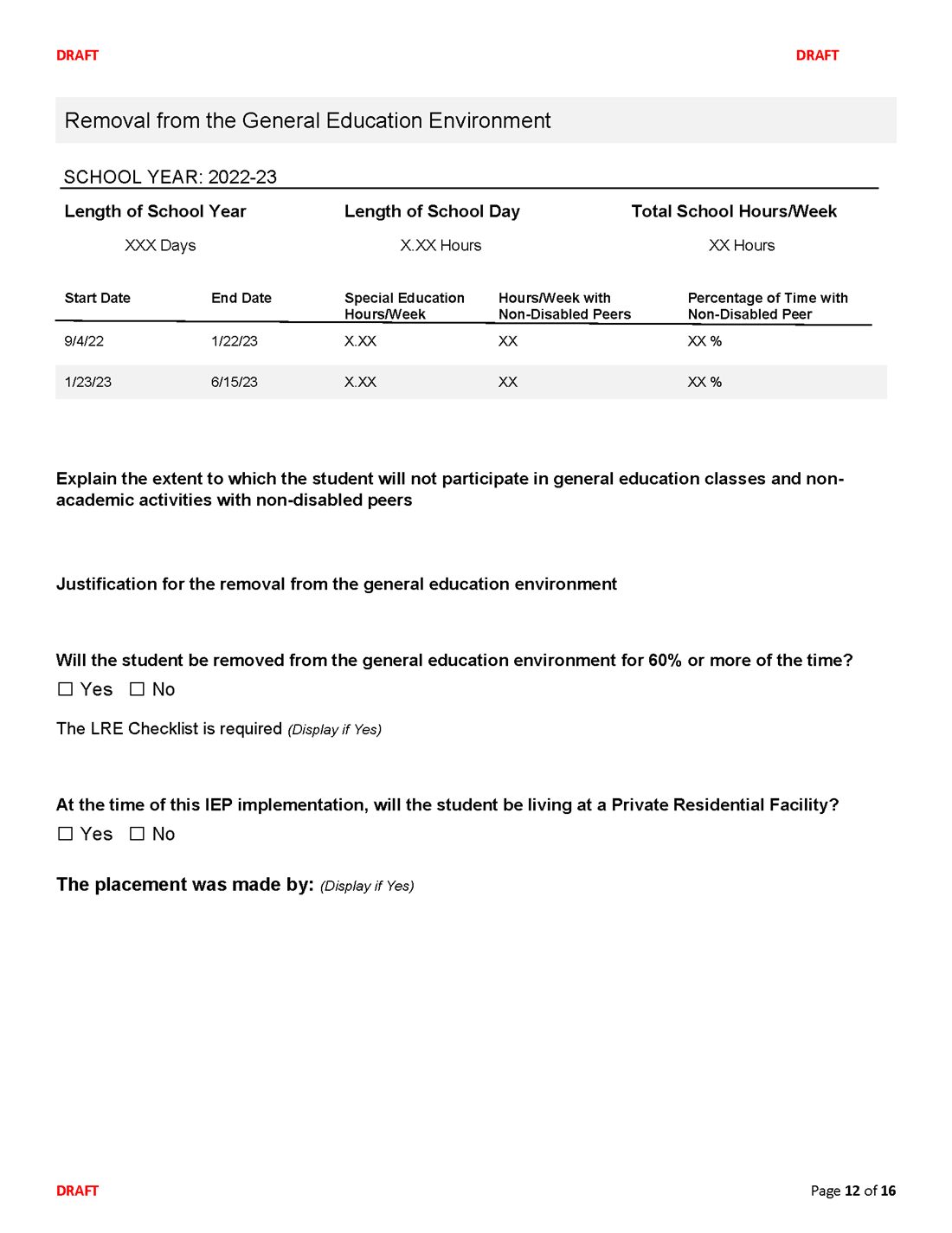
1Removal from the General Education Environment
If your child will be taught outside the regular classroom for part or all of the school day, it is noted here. Your child should only be removed from regular education when they cannot be educated there with supplementary aids and services.
Your child has the right to be educated with their non-disabled peers to the greatest extent appropriate for your child. This is called the least restrictive environment (LRE).
If the school proposes moving your child to a more restrictive setting, or you believe your child is being removed from regular education unnecessarily, it may be time to consult an attorney.
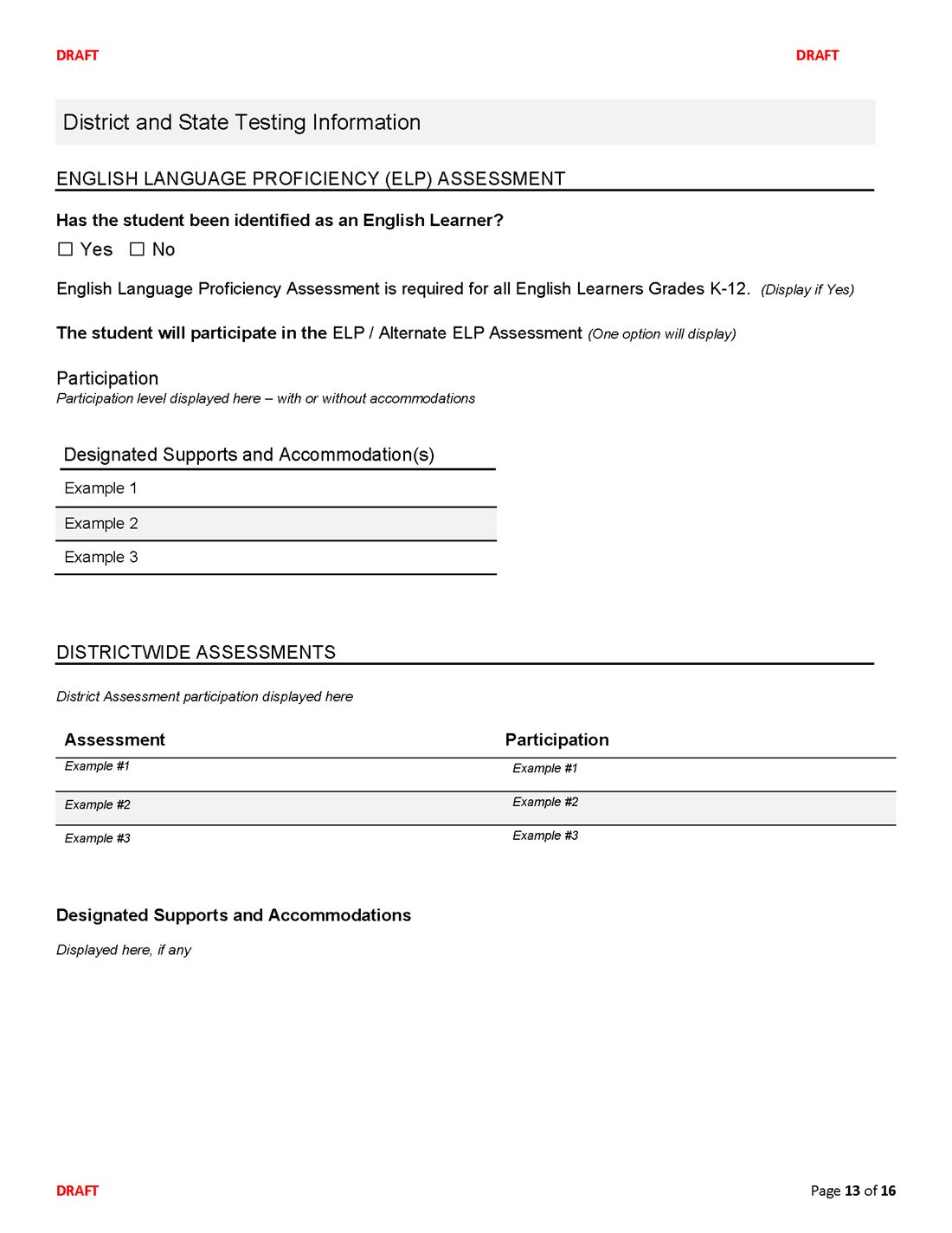
1District and State Testing Information
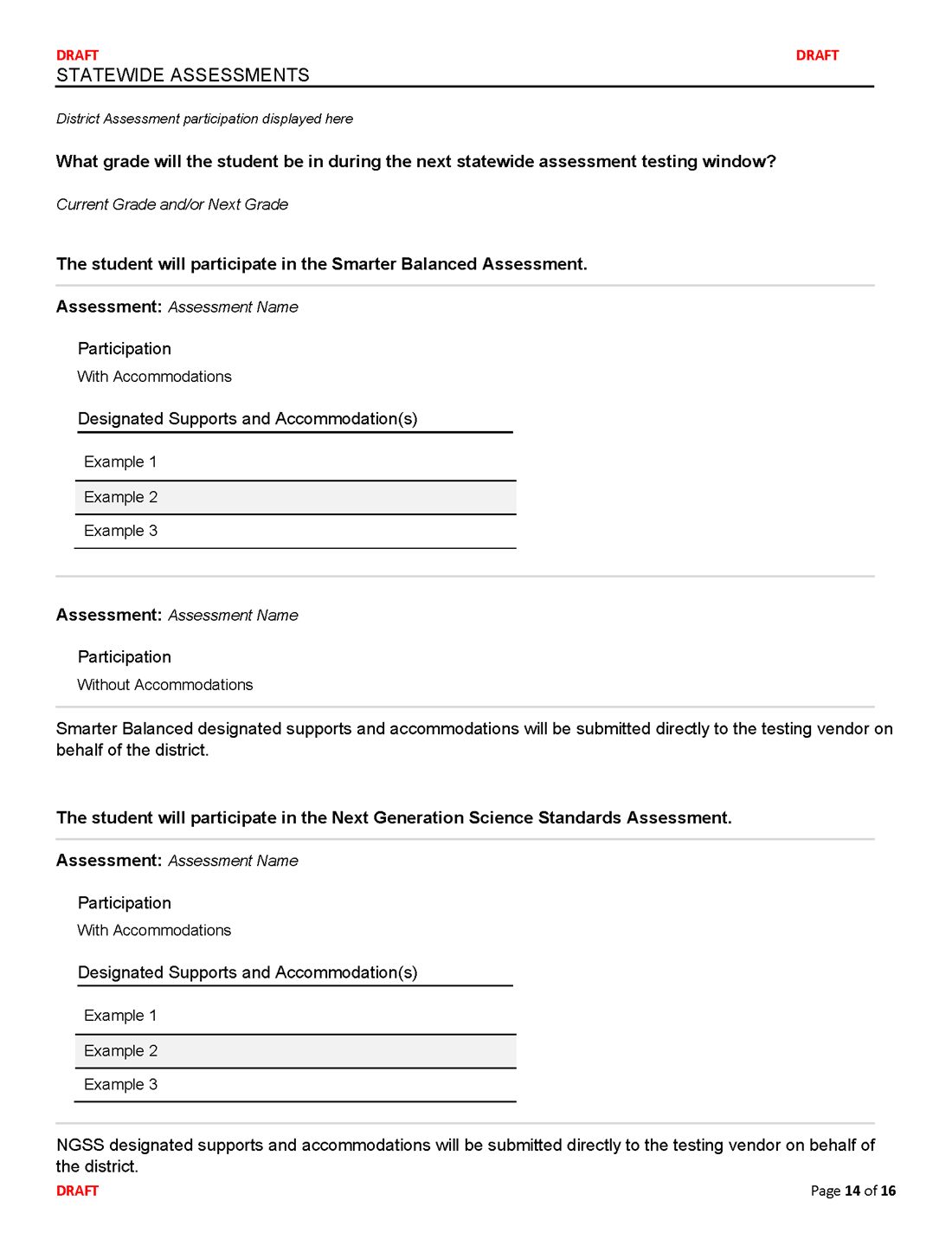
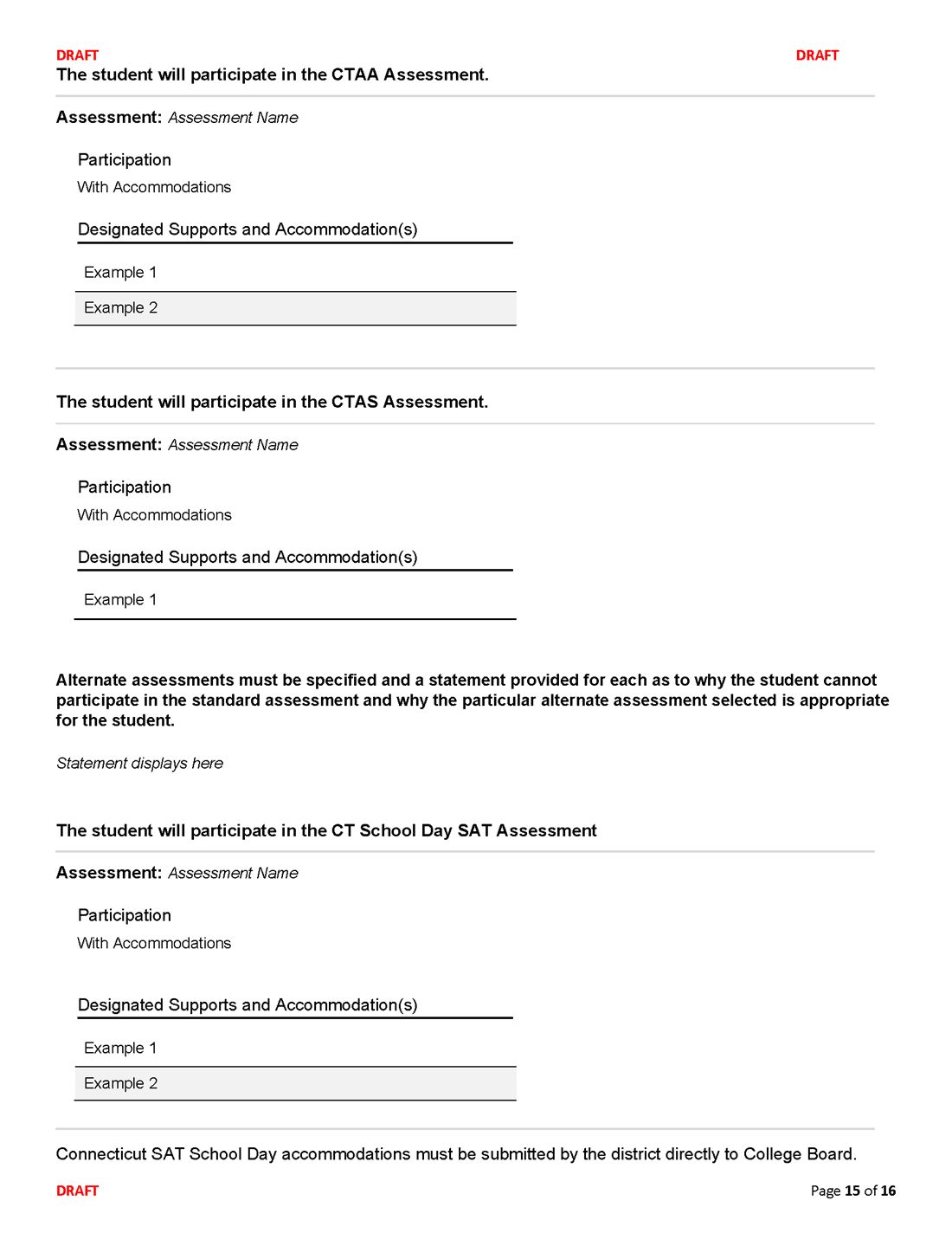
This is how your child will take district and state tests, either with or without accommodations, like extended time or a quiet room, or through an alternate assessment. These tests can affect how progress is tracked, graduation requirements, and planning after high school, so think these decisions through carefully.
1Alternate Assessments
Alternate assessments are for students with significant disabilities. If your child requires an alternate assessment, the IEP should explain why your child cannot take the standard test and why the chosen alternate assessment is appropriate.
The decision should be based only on your child's needs, never on improving the school's test scores.
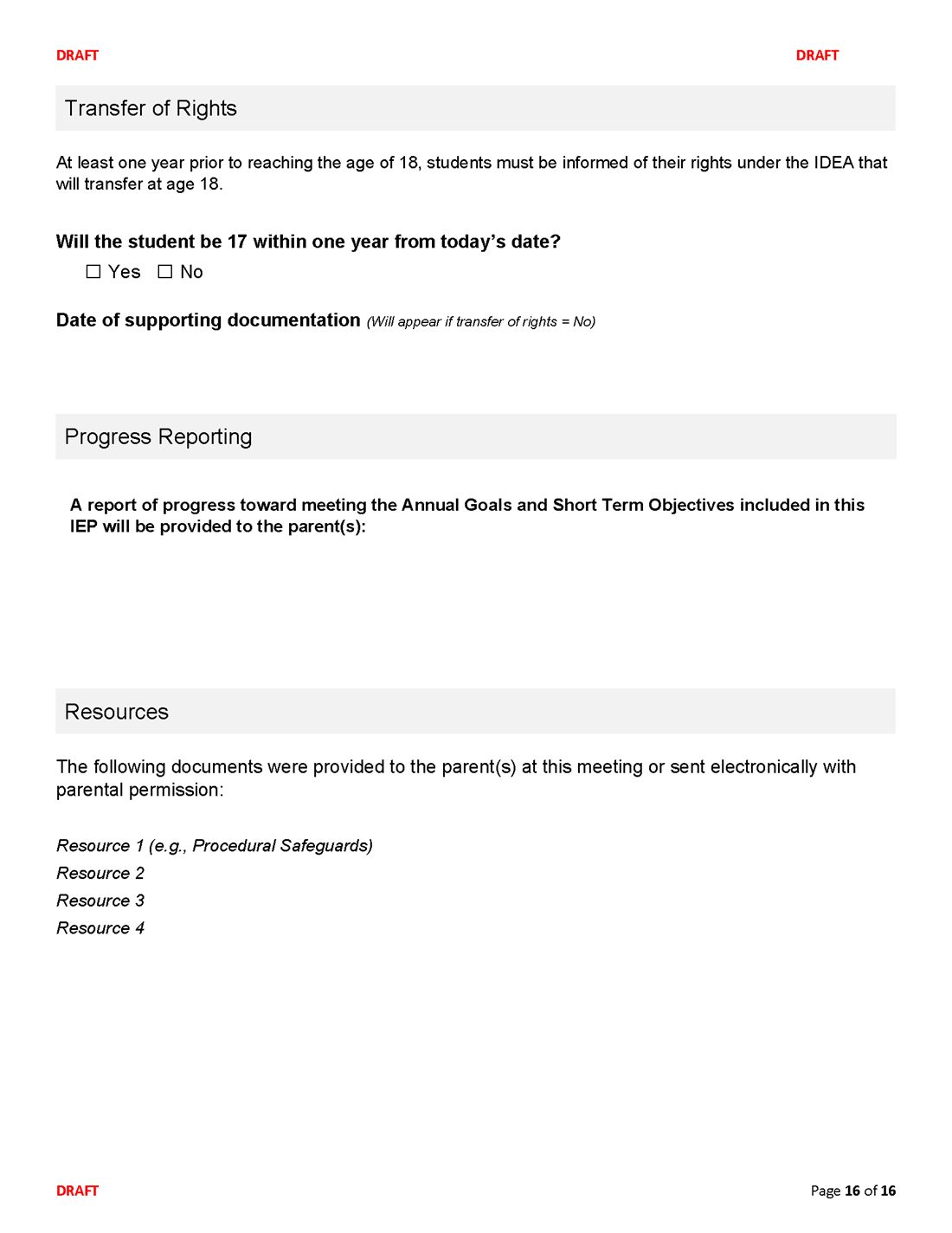
1Transfer of Rights
When your child turns 18, the rights you hold under the IDEA transfer to your child, and your child will make all decisions about their education. If your child would like you to continue making decisions, they can give you an educational power of attorney. Contact my office to find out how to do this.
2Progress Reporting
How often you will receive progress reports on your child's goals is listed here, often at the same time as report cards. The reports should show how your child is doing on each goal, so you and the team can tell whether the supports are working and make changes if needed. Progress should be measured in the same way the objectives are written. If an objective uses a number of trials, for example, a percentage is not helpful.
3Resources
Any resources shared at the IEP meeting should be listed here. These may include agencies, local or state services, reading materials, trainings or workshops, and websites.
Questions About Your Child’s IEP?